
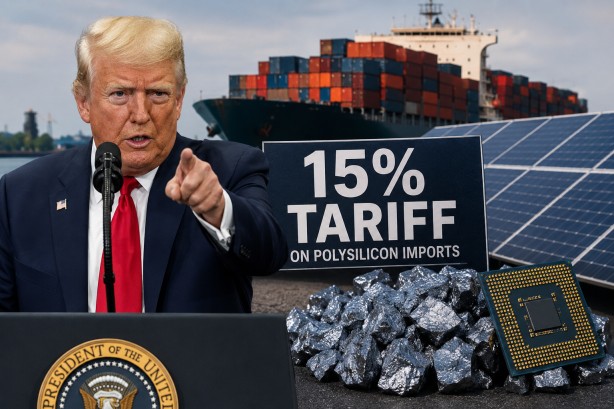
In a bid to bolster domestic manufacturing and reduce dependence on Chinese imports, US President Donald Trump has announced the implementation of a 15% tariff on products made with polysilicon. This tariff, set to commence on December 4, targets a critical material pivotal in the production of semiconductors and solar panels. Polysilicon, an ultra-pure form of silicon, is essential in creating semiconductors that drive artificial intelligence systems, data centers, and solar technologies. China currently dominates the global market for polysilicon production.
The new tariff policy includes minimum import price stipulations: $21 per kilogram for polysilicon, $100 per kilogram for polysilicon ingots and wafers, $0.22 per watt for solar cells, and $0.38 per watt for solar modules and panels. These measures are part of the administration’s strategy to enhance the competitiveness of the US polysilicon industry and fortify supply chains critical to both economic interests and national security.
Criticism has come from China, which contends that the US is leveraging national security as a pretext to impose trade restrictions on Chinese businesses. China warns that such protectionist policies could lead to trade disruptions between the two countries. Despite these tensions, China continues to report robust growth in exports, particularly in electronics, AI-related products, and other high-value sectors.
The US polysilicon sector is currently represented by two main production facilities: Hemlock Semiconductor based in Michigan and Wacker Chemie operating out of Tennessee. The Trump administration’s tariff plan also includes provisions for establishing incentives aimed at encouraging companies to invest in US-based polysilicon and related manufacturing capabilities.